The Dow recovered over half of Thursdays decline overnight as Microsoft surged +15.5% after strong Azure cloud growth reinforced confidence that AI infrastructure spending is yielding results, sparking a broad rebound across semiconductor stocks. The iShares Semiconductor ETF (SOXX) climbed more than +8%, with Micron Technology jumping +18% and AMD rising more than +13%, while South Korean memory giant SK Hynix rallied over +17%. The move reignited the momentum trade, with the iShares MSCI USA Momentum Factor ETF (MTUM) gaining more than +5% as investors rotated back into AI-linked names.
In contrast, Meta Platforms fell 8% after issuing softer revenue guidance and reporting a 91% decline in second-quarter free cash flow. Volatility may be high at the stock level, but this earnings season continues to support US indices, with ~68% of stocks beating EPS and ~79% on the revenue line - the balance of the S&P 500 stocks are due to report in the coming fortnight, with the local names also getting ready to face the music in August.
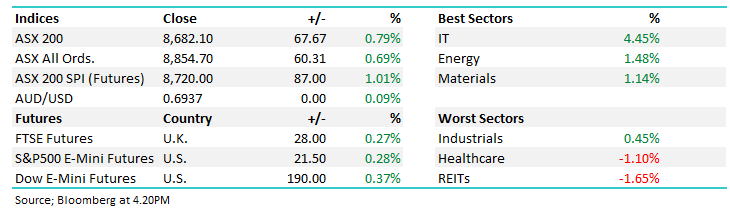
The ASX 200 surged through 9000 yesterday, closing up +1% at a fresh 4-month high, supported by a soft inflation read (CPI). Gains were fairly broad-based for a triple-digit day with ~70% of the main board advancing, led by the rate-sensitive stocks. As we’ve alluded to in the last few morning reports, the ASX has been getting its mojo back of late, and the soft CPI hasn’t hurt the backdrop for local stocks. Even the Australian Financial Review quoted our comments along these lines overnight:
The ASX 200 delivered a stellar albeit surprising performance on Tuesday, reversing early losses to close up +0.6%, posting a 6-week high in the process. The buying gathered momentum after lunch ahead of todays pivotal CPI inflation read, with bonds also strong; it felt like some hawks were squaring their positions in case the CPI comes in softer than expected. However, what was most impressive about the performance was the manner in which the local market shrugged off weakness across the region, where the KOSPI (-11%) and Japanese Nikkei (-4%) combined with weak US futures to paint a clouded picture for risk assets.
The ASX 200 surged +1.4% higher on Monday, delivering its best day in 6 weeks with 85% of the main board closing in positive territory. Only the energy sector closed lower as Middle East tensions eased, sending oil plunging ~9% and global bonds and equities rallied in a classic “risk-on session” for stocks. Ironically, as we head into the uncertainty of Wednesday's Australian Inflation read, it was the sharp reversal higher in bonds (yields lower) following oil's weakness that helped drive rate-sensitive stocks up on Monday, with Tech (+4.5%), Materials (+2.4%), and Real Estate (+1.7%).
US credit markets are the most hawkish they’ve been in the last 2 years, pricing in one and probably two 0.25% rate hikes by Christmas - not that long since their last rate cut by 0.25% in Dec’25, the final move in an aggressive 1.75% easing cycle. Markets have increased rate hike expectations this month following hawkish Fed signals, renewed inflation concerns from higher oil prices, and rising long-term bond yields as heavy government borrowing increased. A cooler-than-anticipated inflation print (CPI) earlier in the month helped, but the oil price quickly became the overriding factor.
The week's most-watched ETFs tell a consistent story, the AI and semiconductor trade is cracking at the edges, inverse and bear products are seeing genuine retail interest for the first time in months, and international equity ETFs are absorbing record inflows as the broadening rotation away from US exceptionalism accelerates. However, funds continue to flow into stocks, with fund flows into active primary equity ETFs totalling more than US$17.5 billion for the week ending July 24, 2026.
US stocks rose on Tuesday, led by semiconductor stocks, as investors looked through the latest developments in the Iran conflict and shifted their focus to a solid start to the US earnings season. Industrial giant 3M jumped more than 7% after delivering a stronger-than-expected second-quarter result, while General Motors gained nearly 5% after beating earnings and revenue forecasts. The reporting season has begun strongly, with almost 88% of the 66 S&P 500 companies that have reported so far beating earnings expectations. Attention now turns to results from Alphabet, IBM and Tesla later this week.
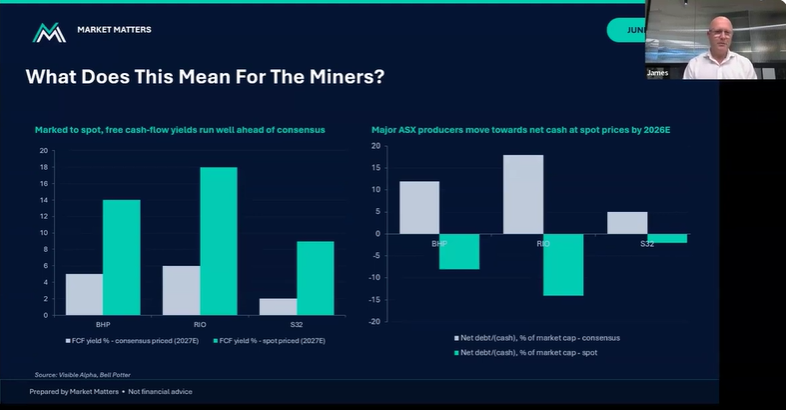
The lithium trade has lost its mojo in the last few months, but we believe the demand side of the equation remains healthy for lithium as battery energy storage emerges as a 2nd pillar of lithium demand alongside EVs, driven by AI data centres and rising global investment in storage.
As we flagged in June, lithium supply is continuing to grow, with analysts divided on when the market will return to deficit—some expect 2026–27, while others don't see it until 2030. At MM, we remain bullish on the long-term structural drivers supporting spodumene and believe prices can ultimately move well above their 2026 highs. However, after the sector's strong gains over the past 12 months, this current pullback is understandable.
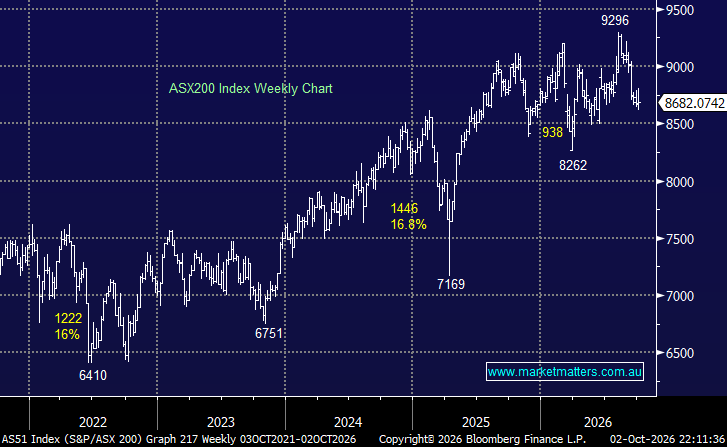
Equities have been volatile through 2025–26, unsettled by both the Liberation Day tariff shock and the US-Iran conflict, yet despite the relentless headlines, the ASX 200 has gained less than 1% since the start of 2025. However, on the stock and sector level in particular, volatility has been even more pronounced due to the combination of increased leverage and crowded positioning:
The ASX 200 surged through 9000 yesterday, closing up +1% at a fresh 4-month high, supported by a soft inflation read (CPI). Gains were fairly broad-based for a triple-digit day with ~70% of the main board advancing, led by the rate-sensitive stocks. As we’ve alluded to in the last few morning reports, the ASX has been getting its mojo back of late, and the soft CPI hasn’t hurt the backdrop for local stocks. Even the Australian Financial Review quoted our comments along these lines overnight:
The ASX 200 delivered a stellar albeit surprising performance on Tuesday, reversing early losses to close up +0.6%, posting a 6-week high in the process. The buying gathered momentum after lunch ahead of todays pivotal CPI inflation read, with bonds also strong; it felt like some hawks were squaring their positions in case the CPI comes in softer than expected. However, what was most impressive about the performance was the manner in which the local market shrugged off weakness across the region, where the KOSPI (-11%) and Japanese Nikkei (-4%) combined with weak US futures to paint a clouded picture for risk assets.
The ASX 200 surged +1.4% higher on Monday, delivering its best day in 6 weeks with 85% of the main board closing in positive territory. Only the energy sector closed lower as Middle East tensions eased, sending oil plunging ~9% and global bonds and equities rallied in a classic “risk-on session” for stocks. Ironically, as we head into the uncertainty of Wednesday's Australian Inflation read, it was the sharp reversal higher in bonds (yields lower) following oil's weakness that helped drive rate-sensitive stocks up on Monday, with Tech (+4.5%), Materials (+2.4%), and Real Estate (+1.7%).
US credit markets are the most hawkish they’ve been in the last 2 years, pricing in one and probably two 0.25% rate hikes by Christmas - not that long since their last rate cut by 0.25% in Dec’25, the final move in an aggressive 1.75% easing cycle. Markets have increased rate hike expectations this month following hawkish Fed signals, renewed inflation concerns from higher oil prices, and rising long-term bond yields as heavy government borrowing increased. A cooler-than-anticipated inflation print (CPI) earlier in the month helped, but the oil price quickly became the overriding factor.
The week's most-watched ETFs tell a consistent story, the AI and semiconductor trade is cracking at the edges, inverse and bear products are seeing genuine retail interest for the first time in months, and international equity ETFs are absorbing record inflows as the broadening rotation away from US exceptionalism accelerates. However, funds continue to flow into stocks, with fund flows into active primary equity ETFs totalling more than US$17.5 billion for the week ending July 24, 2026.
US stocks rose on Tuesday, led by semiconductor stocks, as investors looked through the latest developments in the Iran conflict and shifted their focus to a solid start to the US earnings season. Industrial giant 3M jumped more than 7% after delivering a stronger-than-expected second-quarter result, while General Motors gained nearly 5% after beating earnings and revenue forecasts. The reporting season has begun strongly, with almost 88% of the 66 S&P 500 companies that have reported so far beating earnings expectations. Attention now turns to results from Alphabet, IBM and Tesla later this week.
The lithium trade has lost its mojo in the last few months, but we believe the demand side of the equation remains healthy for lithium as battery energy storage emerges as a 2nd pillar of lithium demand alongside EVs, driven by AI data centres and rising global investment in storage.
As we flagged in June, lithium supply is continuing to grow, with analysts divided on when the market will return to deficit—some expect 2026–27, while others don't see it until 2030. At MM, we remain bullish on the long-term structural drivers supporting spodumene and believe prices can ultimately move well above their 2026 highs. However, after the sector's strong gains over the past 12 months, this current pullback is understandable.
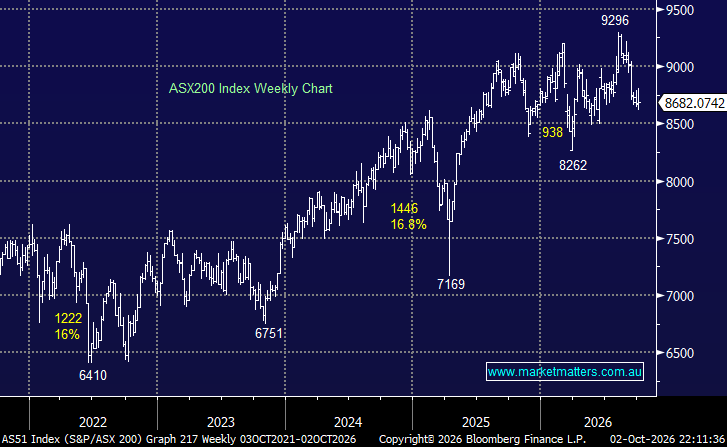
Equities have been volatile through 2025–26, unsettled by both the Liberation Day tariff shock and the US-Iran conflict, yet despite the relentless headlines, the ASX 200 has gained less than 1% since the start of 2025. However, on the stock and sector level in particular, volatility has been even more pronounced due to the combination of increased leverage and crowded positioning:
Check your email for an email from [email protected]
Subject: Your OTP for Account Access
This email will have a code you can use as your One Time Password for instant access
Verication email sent.
Check your email for an email from [email protected]
Subject: Your OTP for Account Access
This email will have a code you can use as your One Time Password for instant access
!
Invalid One Time Password
Please check you entered the correct info, please also note there is a 10minute time limit on the One Time Passcode
To reset your password, enter your email address
A link to create a new password will be sent to the email address you have registered to your account.
Market Matters members receive daily market reports, real-time trade alerts, full access to 5 portfolios and dynamic company data.
Choose how you'd like to proceed:
We have a range of membership options to suit your needs and budget, why not join today and get unlimited access to the premium Market Matters service.